
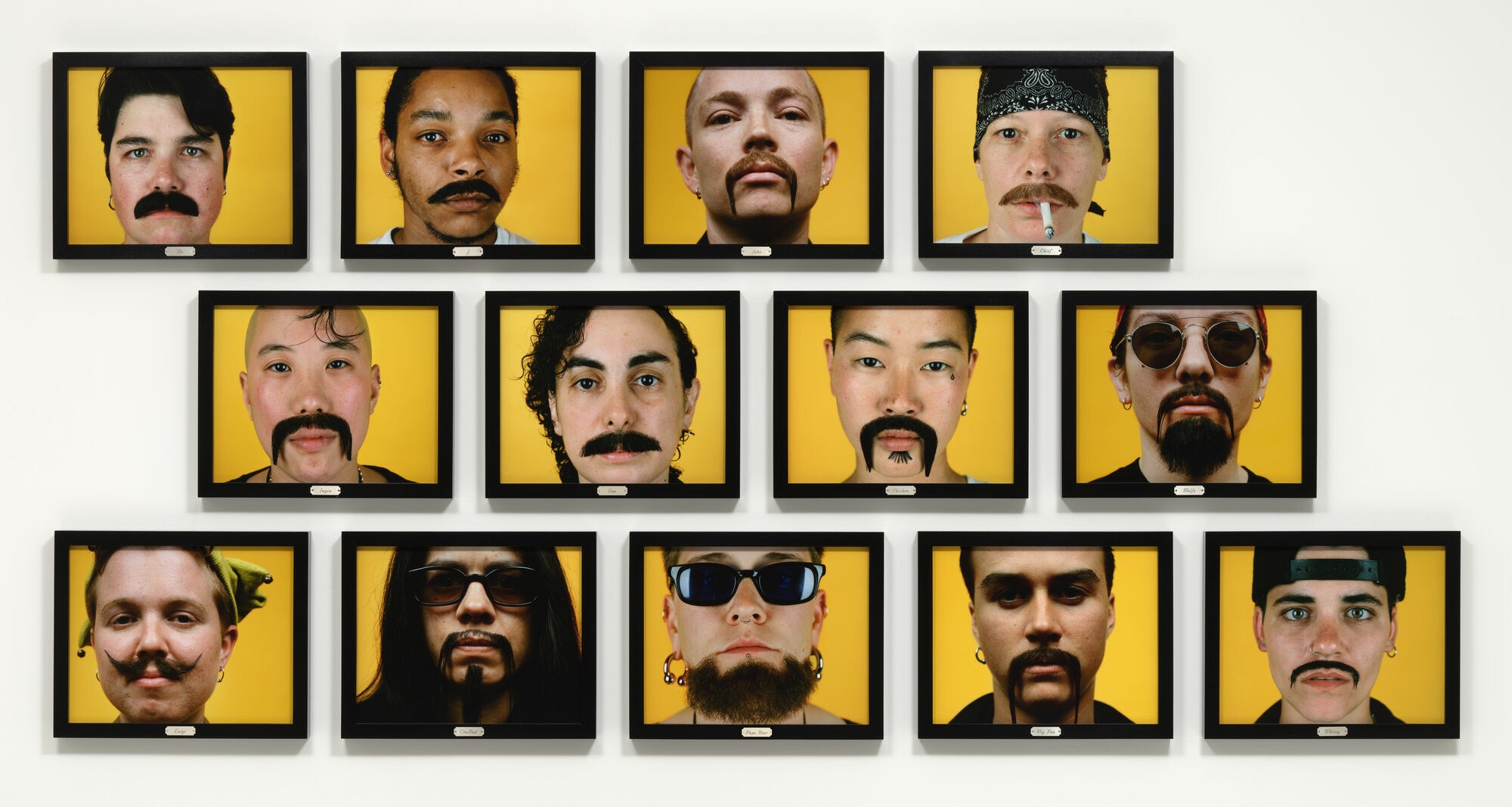
Catherine Opie: Being and Having (Chicken), 1991
The world of art is truly amazing. It's made up of people from all backgrounds and nationalities. But one thing is especially surprising. The artwork done by women makes up only 11% of purchases, and 14% of their exhibits are shown in 26 museums (Solly, 2019). This was also between the years of 2008 and 2018.
Community, identity, and queer visibility
For artists like Catherine Opie, she is getting the word out that women can be as strong as any man. But it's more than just showing the masculine side; it's about community — it's about letting people know, especially those in the lesbian and queer community, that you are not alone (Moma, 2023).
In this artwork, Opie shows that gender roles are constructed; they are not inherently true. For this artwork, she invited some of her lesbian and queer friends to join her in creating Being and Having. 1991 (Chicken). She never expected it to really go anywhere, but it did. And Opie is very proud to be part of the conversation when it comes to, as she says, "queer art".(Moma, 2023). We are also looking differently at sexuality. Catherine Opie's portraits also change how we view sexuality and are bending the harsh cultural codes that say sexuality is fixed and binary only. The way that Opie presents her work gives dignity and pride to women and is pushing back on society's rigid rules on those who are LGBTQIA+ The main character of "Chicken" is Jenny Shimizu, who is also an artist, model, actor, and filmmaker. There is a picture of her with a glued-on Mustache. She is against a vibrant yellow backdrop; she is the 3rd picture in the 2nd row of photographs. Catherine Opie uses different people, including herself, in these photographs. In away she is challenging everything we think we know about gender and masculinity. Also, she challenges what we know about sexuality as well. She is slipping into another skin, almost like putting on a mask. Showing us that the reality we know may not be reality at all. There are also the name plates that are masculine in nature. They are fixed to the pictures, calling out to be remembered and go down in history as just as important as anyone. A group of people that history should remember, not just as a minority group of the LGBTQIA+, but as those who matter, as human beings.
Deconstructing gender through performance
What she is doing in this artwork is a multitude of tasks. Opie is showing that gender is not as stable as we believe it to be. Gender isn't binary; it's mutable, changing, fluid. Masculinity — being this macho man — is rather an exaggeration. She is also showing a side of the LGBTQIA+ community, especially at the height of the AIDS epidemic, that this is a conversation that needs to be had, and that LGBTQIA+ is part of that community. She is breaking down the walls and structure of the heterosexual construct and giving homosexuality a voice (Carey, 2008). The pictures show her lesbian and trans friends in mustaches, and if you look closely, you can see that the mustaches are glued on — showing how masculinity is simply a construct that culture and society have made up (Carey, 2008).
Simone de Beauvoir, in her 1949 book "The Second Sex," wrote that women are simply the "other" when it comes in relation to men. Both she and Ann Oakley argued that gender roles are learned behaviors and that these are constructed by society (Institute, 2025). In her 1972 book Sex, Gender and Society, she says that a woman being a domestic housewife isn't normal and goes against what is natural for a woman. But both women argued that gender is made up and heavily influenced by the media, school, and society at large. Judith Butler also came out with a Book in 1990, published in 1999, around the time that Opie did her Being and Having (Chicken), 1991. It is a visual journey that reflects Butler's work that biology is not fixed (Butler, 1999). Feminists, though, view Catherine Opie's Being and Having (Chicken), 1991 as something to be celebrated. Gender is not biologically fixed; it can be changed. Catherine Opie has made a very powerful statement in her artwork. But going back to Mulvey, I believe she would find that Catherine Opie and Chicken have managed to shatter that " to-be-looked-at-ness " completely(Mulvey, 1975). There is no looking away from that camera lens; they are staring at it with power and unflinching fearlessness. It is deconstructing everything the silent cultural codes have taught us about masculinity and feminism. The viewer or audience is simply left looking at the images in front of them, the pure truth that masculinity may be all theatrical patchwork. Design Statement - I found Catherine Opie's Being and Having (Chicken), 1991, actually quite interesting. It really does challenge the way in which you see gender and sexuality. The way that Opie goes about her portraits of different women, and how easy it is to just slip into another skin, just like a mask, is incredible. It's as though you can see gender in fluidity. I don't think she is mocking masculinity, but she is taking a deeper dive into what it means to be both masculine and feminine. You can see both sides of the coin.
References
Bane, T. (2026). Simone de Beauvoir: Existentialism, Phenomenology, Feminism. Brooklyn Institute for Social Research. https://thebrooklyninstitute.com/items/courses/new-york/simone-de-beauvoir-existentialism-phenomenology-feminism-seattle/
Butler, J. (1999). Gender trouble. Routledge. https://selforganizedseminar.wordpress.com/wp-content/uploads/2011/07/butler-gender_trouble.pdf
Carey, J. M. (2008, January 15). Photo of the week: "Chicken" by Catherine Opie, 1991, from the series Being and Having. German Modernism. https://germanmodernism.org/2008/01/15/photo-of-the-week-chicken-by-catherine-opie-1991-from-the-series-being-and-having/
Institute, S. (2025). Distinguishing sex, gender, and social constructs in sociology. Sociology of Gender. https://sociology.institute/sociology-of-gender/sex-gender-social-constructs-sociology/
MoMA. (2023). Catherine Opie: Being and Having. 1991. Queer Highlights [Audio]. Museum of Modern Art. https://www.moma.org/audio/playlist/333/4384
Mulvey, L. (1975). Visual pleasure and narrative cinema. Screen, 16(3), 6–18. https://doi.org/10.1093/screen/16.3.6
Oakley, A. (2026). Welcome to Ann Oakley’s website. Ann Oakley. https://www.annoakley.co.uk/index.html
Opie, C. (1991). Being and Having [Photograph series]. Museum of Modern Art. https://www.moma.org/audio/playlist/298/4384
Solly, M. (2019). Study shows U.S. museums still lag when it comes to acquiring works by women artists. Smithsonian Magazine. https://www.smithsonianmag.com/smart-news/survey-us-museums-reveals-few-gains-female-artists-past-decade-180973190/