
Reading the Comparison
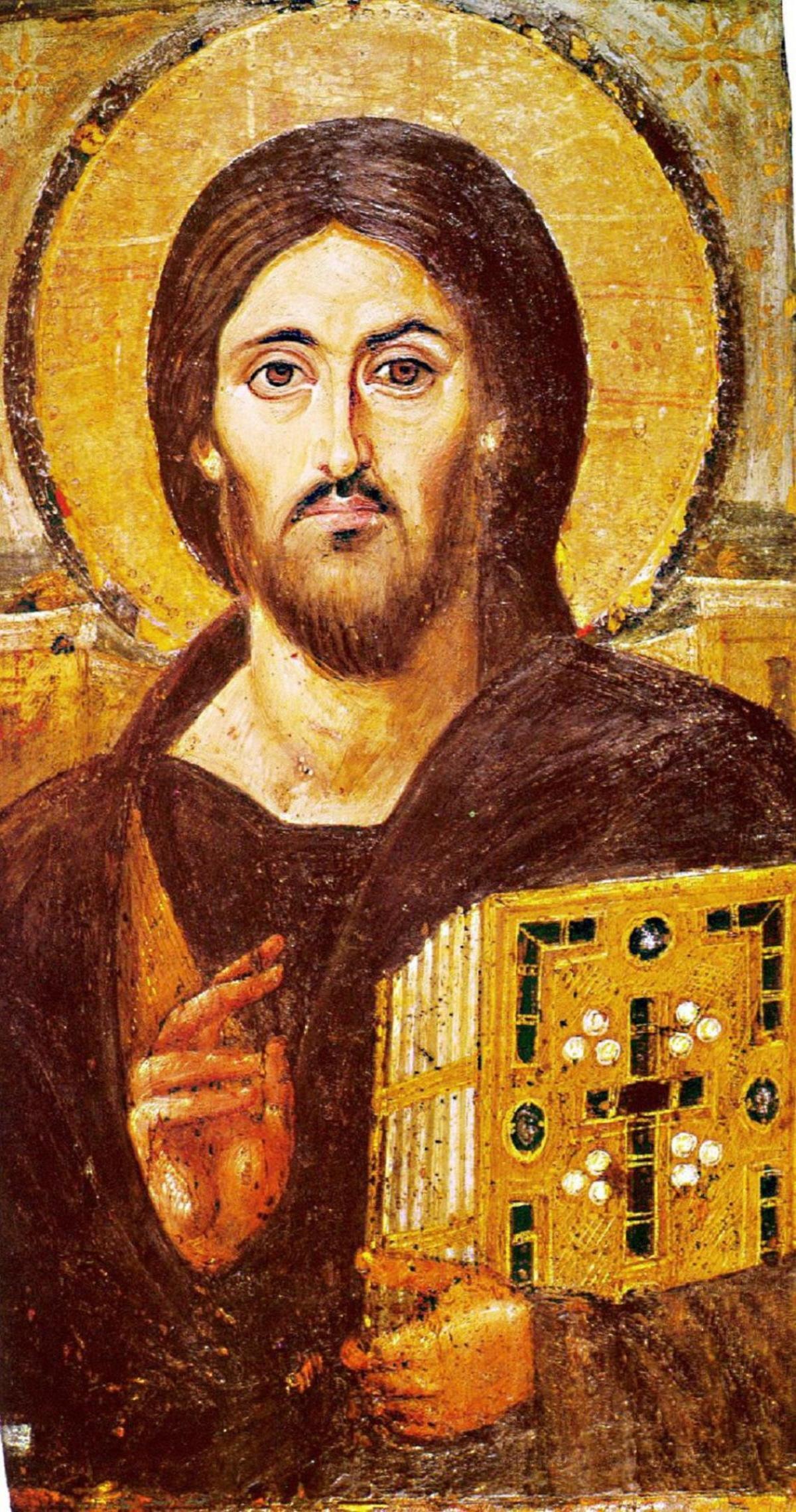
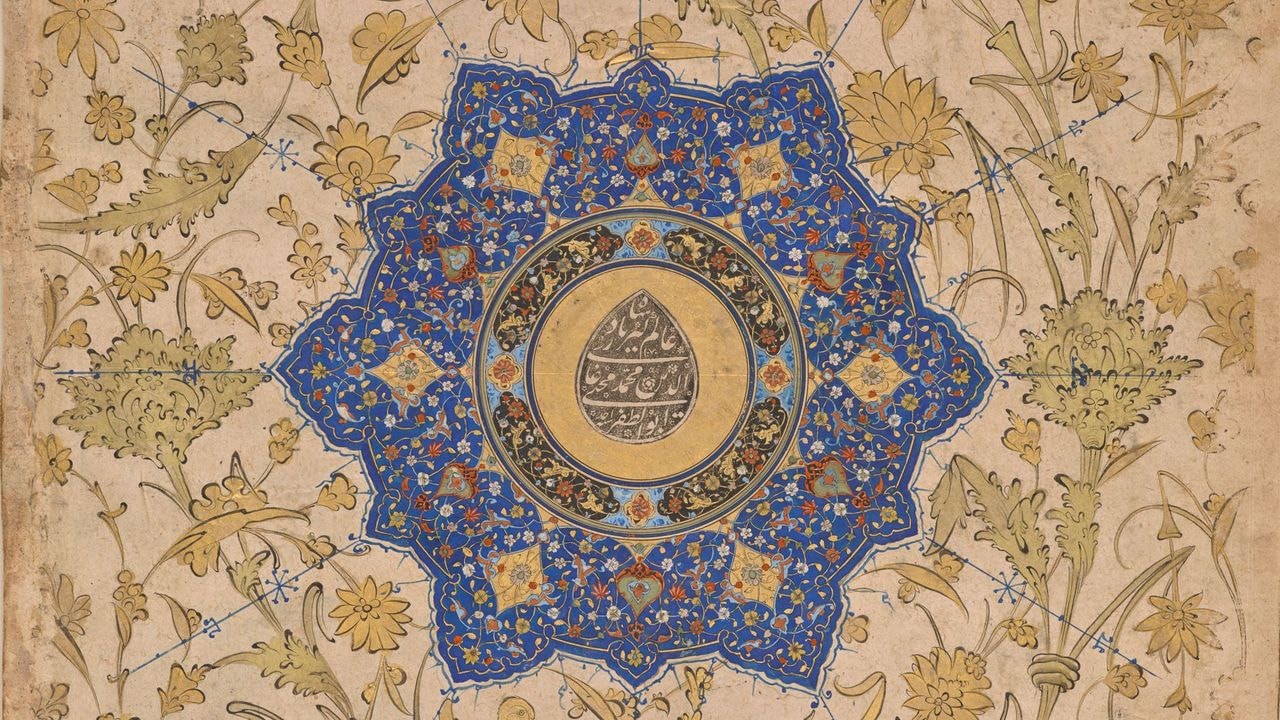
Begin with composition, because it is the most immediate shared element. Both works are built on the principle of the radiant center. The Pantocrator compresses the entire theological program of the icon into a frontal bust: Christ's face at the exact center of the panel, flanked symmetrically, framed by the disc of the halo (Weitzmann, 1976). The Dome of the Rock performs the same act in three dimensions: an octagonal shrine with the sacred rock at its exact center, the dome crowning it, so that pilgrims walk around the center rather than standing before it (Grabar, 1973). In both, meaning depends on centering — but the direction differs. The icon pulls the viewer's gaze inward, toward a human face; the dome sets the worshipper in motion around a sacred place.
Color carries the argument. Both works reserve their costliest material — gold — for the sacred itself. The icon's gold ground abolishes earthly space altogether, suspending Christ in a field of uncreated light, while his halo extends that light to its source (Weitzmann, 1976). The Dome of the Rock deploys gold as architecture: the original gilded dome and gold mosaic interior pour that same light over the sacred rock. The blue tile exterior visible today is a 16th-century addition by Suleiman the Magnificent; the first building was even more of a golden cousin to the icon (Ettinghausen, Grabar & Jenkins, 2001). In both traditions, the message of the palette is the same: this is not the color of the world, but of the realm behind it.
The two works also agree on what belongs at the center: the word. In the icon, the Word made flesh holds a jeweled Gospel book, its cover set with gems and a cross — scripture rendered as sacred object, carried in the body of Christ (Weitzmann, 1976). In the Dome of the Rock, the Word is made architecture: a band of Qur'anic calligraphy wraps the interior arcade, and this inscription is famously polemical — it directly addresses Christian doctrine about Christ, making the building a theological argument in script (Grabar, 1973; Blair & Bloom, 1994). Here the comparison sharpens into theology. Christianity's doctrine of the Incarnation makes the depicted sacred body not merely permitted but necessary, so the icon's book is an attribute of a person. Islam's aniconic tradition channels the same reverence into the text and its setting, so that the dome honors the word by enclosing rather than depicting (Grabar, 1973).
Gesture completes the contrast. The Pantocrator raises his right hand in blessing and fixes the viewer with enlarged, unblinking eyes — a gesture that crosses the boundary of the panel and addresses each viewer personally, a convention of the Pantocrator type since its earliest surviving examples (Weitzmann, 1976). The Dome of the Rock contains no figures at all — and yet it gestures. Its architecture addresses every visitor who enters: the dome overhead replaces the halo above, the calligraphic band replaces the Gospel book, and the sacred rock at the center replaces the body of Christ as the focal point of devotion (Grabar, 1973). One work blesses through a face; the other through a building.
Read together, the two works show two theologies of the image drawing on one artistic intelligence. Both became prototypes: the Pantocrator type echoes through a millennium of Orthodox icon painting (Weitzmann, 1976), while the Dome of the Rock established the visual vocabulary of Islamic sacred architecture across the medieval world (Blair & Bloom, 1994). Both argue — in gold, symmetry, and centered light — that the sacred is best approached through radiance rather than narrative. The comparison does not dissolve the difference between an incarnate God and a deity known through the word and the place; it shows how each tradition built a complete visual world from the same few convictions about what holiness looks like.
Sources
- Weitzmann, K. (1976). The Monastery of Saint Catherine at Mount Sinai: The Icons, Volume One. Princeton University Press.
- Grabar, O. (1973). The Formation of Islamic Art. Yale University Press.
- Blair, S., & Bloom, J. (1994). The Art and Architecture of Islam 1250–1800. Yale University Press.
- Ettinghausen, R., Grabar, O., & Jenkins, M. (2001). Islamic Art and Architecture: 650–1250 (2nd ed.). Yale University Press.
- The Metropolitan Museum of Art. (n.d.). Heilbrunn Timeline of Art History. Retrieved from https://www.metmuseum.org/toah/
- Encyclopaedia Britannica. (n.d.). Icon; Dome of the Rock; Islamic arts. Retrieved from https://www.britannica.com/