
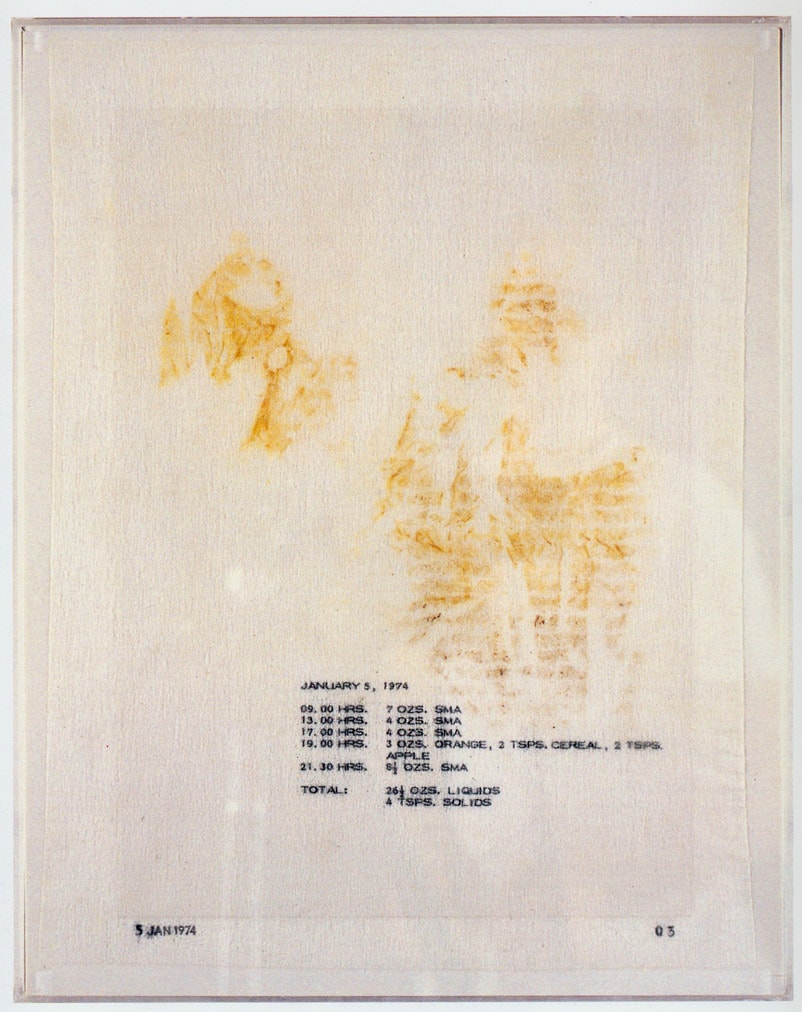
Mary Kelly is an American artist born in 1941 whose practice sits at the intersection of conceptual art, feminist theory, and psychoanalysis. Her most celebrated — and most controversial — work, Post-Partum Document (1973–79), challenged the art world at a moment when that world was almost entirely male-dominated. By displaying the stained lining of her infant son's diaper alongside feeding charts and meticulous documentation of his early development, Kelly did something that had never quite been done before: she made the invisible labour of motherhood the subject of serious, rigorous art.
In the 1970s, the art world was not a welcoming space for women, and it was even less welcoming for the kind of subject matter Kelly brought into the gallery. Post-Partum Document was not a painting of a mother and child in the tradition of the Madonna. It was not decorative, not sentimental, and not designed to please the eye of a viewer accustomed to seeing women as objects of beauty. What Kelly presented instead were artefacts of care: stained fabric, feeding records, transcriptions of her son's early speech. The work was deliberately unglamorous, and that was precisely the point.
What Kelly was doing, in the most fundamental sense, was turning psychoanalytic theory on its head — and in particular, turning the logic of the patriarchy against itself. The art world had long been structured around the male gaze: the assumption that the viewer is male, that the subject is female, and that the female body exists to be looked at and desired(Mulvey, 1975). Post-Partum Document removed all of that. There is no attractive woman to objectify or lust over. There are just stained diapers and a feeding chart. And by removing the male gaze, Kelly was doing something radical: she was restoring the presence of the woman to its rightful place, not as an object of desire but as a subject with an interior life, a body that works, and a relationship to the world that is complex and demanding.
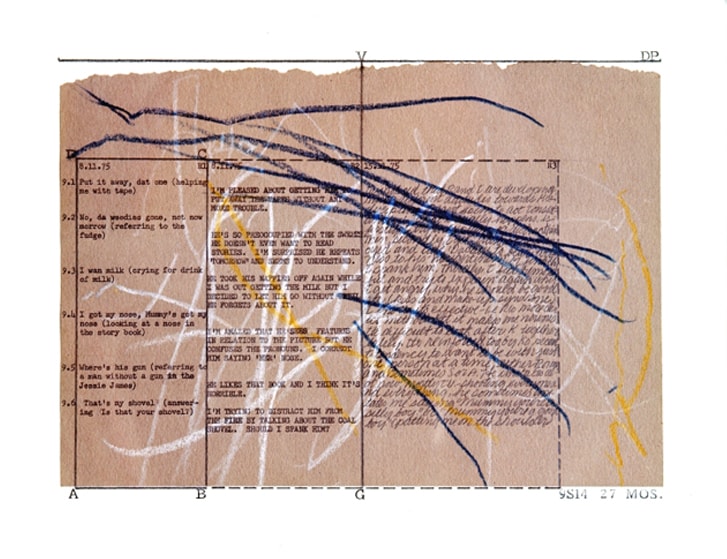
Kelly was also making a social argument. Motherhood, she was saying, is never easy and not always pleasant. It is a never-ending work — physical, psychological, intellectual — and it is work that society has a long history of ignoring or undervaluing. By documenting her son's development with the rigour of a scientist and the attentiveness of a theorist, Kelly was insisting that this work deserved to be taken seriously. She was looking at how identities are constructed — how a child becomes a person, how a woman becomes a mother, and how those two processes are entangled in ways that neither psychoanalysis nor the art world had adequately addressed (Warriner, 2015).
“By removing the male gaze, Kelly was restoring the presence of the woman to its rightful place — not as an object of desire but as a subject with an interior life, a body that works, and a relationship to the world that is complex and demanding.”
Central to the work is Kelly's engagement with the psychoanalytic theories of Jacques Lacan. Lacan's framework looked at how the mother and child enter society as separate individuals — how the child moves from a state of undifferentiated union with the mother into a world of language, law, and social identity. What Kelly's work does, over a five-to-six-year period, is to watch that process unfold in real time. Her son is learning to walk, to talk, to figure things out on his own. But during this time, both mother and child are shaping each other. The document is not just a record of his development; it is a record of hers too (Morinis, 2010). Motherhood, Kelly shows us, is not a passive state but an active, intellectually demanding process — both physical and psychological (Sharpe, 2026; Gerald P. Perman, 2025).
Not everyone, however, was convinced. Some feminists felt that Post-Partum Document was inaccessible — that its theoretical density and its reliance on Lacanian psychoanalysis made it impossible for ordinary women to understand. Instead of bringing women together, they argued, the work risked leaving many of them out. It was a genuine tension, and it reflected a broader debate within second-wave feminism about the relationship between theory and practice, between the academy and the street. Kelly's work demanded a certain kind of literacy, and not everyone had it — or felt they should need it to engage with art about their own lives.
That tension has not entirely resolved itself in the decades since. But what Post-Partum Document has done, undeniably, is to open a space — in galleries, in critical writing, in feminist theory — for the kind of work that takes the experience of women seriously as intellectual and political material. Kelly made motherhood look complex because it is complex. She made social issues look the same way in which the intellect is made of language and societal rules. And in doing so, she changed what art was allowed to be about.
Design Statement
I chose Mary Kelly's work Post-Partum Document (1973–79) because I felt that being a mother is never easy, and with everything going on today, I think it is an important conversation to have. We look at the mothers and their babies and we don't think much, but maybe we say that is so sweet. But underneath, we don't know the sleepless nights, the cleaning up of messes, the diaper changes, the worry when your child is ill.
We really don't know just how hard it can be to be a mother and raise your children to be the best they can be. There are some wonderful times being a parent, but sometimes it can be very trying. That's what drew me to Mary Kelly — do we really understand motherhood.
References
- Gerald P. Perman, M. (2025). Jacques Lacan: Hiding in Plain Sight. Psychiatric Times. Retrieved from https://www.psychiatrictimes.com/view/jacques-lacan-hiding-in-plain-sight
- Morinis, L. (2010, February 02). UCLA Department of Art Lectures: Mary Kelly. Retrieved from Hammer Museum UCLA: https://vimeo.com/92303347?fl=pl&fe=ti
- Mulvey, L. (1975). Visual pleasure and narrative cinema. Screen, 16(3), 6–18. https://doi.org/10.1093/screen/16.3.6
- Sharpe, M. (2026). Jacques Lacan (1901–1981). Retrieved from Internet Encyclopedia of Philosophy: https://iep.utm.edu/lacweb/
- Warriner, R. (2015, August 9). Mary Kelly, Post-Partum Document. Retrieved from Smarthistory: https://smarthistory.org/mary-kelly-post-partum-document/